
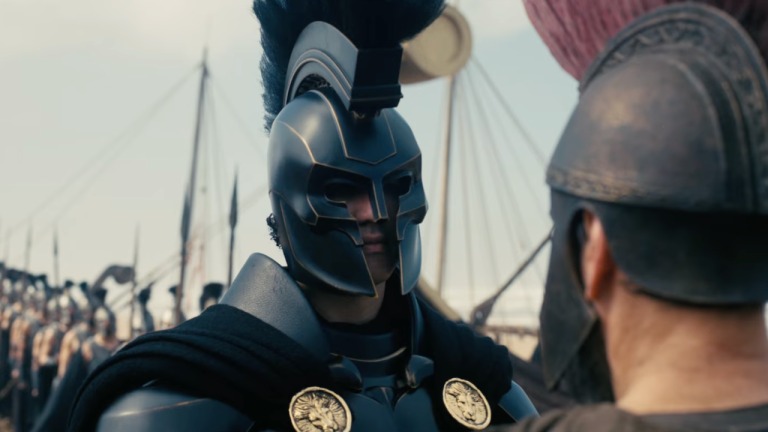
The Odyssey has made history at the box office, taking $600million in global ticket sales in its opening weekend. Christopher Nolan’s Odyssey film fits the modern brief that depressing means intelligent, but art can respond to our dark age less predictably. Bring on a sense of lightness and a bit of colour.
You know what would be epic in The Odyssey? A bit of colour.
In Christopher Nolan’s new film of The Odyssey, the director contrives to make the Homeric Aegean — traditionally imagined as a sun-dazzled realm of white clifftop temples, blue domes and azure harbours — looking like July in Greymouth.
Nolan’s Odysseus is gruff and morally complicated (there is a point in the film where you begin to feel yourself siding with the Cyclops). He forges his way home to Ithaca under lowering skies and across bruised blue-black seas. The emotional weather is not much cheerier. Everyone is certain that the world is falling apart. As one character comments, in an entertainingly unsubtle allusion to the civilisational catastrophe historians call the Bronze Age Collapse, “our Age of Bronze is collapsing”.
If Nolan’s Odyssey makes it on to the film studies courses of the future, it’s not hard to imagine the accompanying seminar elucidating the way the film “speaks to the anxieties of its time”. Perhaps someone will one day run a humanities module on The Morbid 2020s, also featuring the novels of Sally Rooney and a digression on the famous analysis that found 2020s pop music is becoming “sadder” and “more stressful”.
We live in dark times, sure. But I think it is possible to object to the way “more depressing” has become synonymous with “more sophisticated”. When a director is hired to take a film franchise upmarket, the brief is rarely to add levity. Nolan’s own “gritty” Batman films are a case in point. And a scan of recent Oscar winners confirms that any director seeking critical acclaim would be unwise to offer too much in the way of sweetness and light. Nomadland offered a bleak portrait of homelessness in America, Parasite a bleak portrait of economic inequality in South Korea, Oppenheimer a bleak portrait of nuclear Armageddon… Tellingly, no comedy has won best picture since Shakespeare in Love in 1999.
Even Greta Gerwig’s Barbie, a light-hearted hit of recent times, signalled its aspirations to sophistication by weaving in some pessimistic commentary on contemporary womanhood. Subjects of recent Booker prizewinning novels include alienated masculinity, the Sri Lankan civil war, the misery of life in working-class Glasgow and democratic collapse.
The idea that melancholy is a mark of artistic sophistication is as old as Aristotle. But few ages have embraced it more than our own. Partly, of course, it is the anxious tenor of the age. But then other ages were also grim. The 20th century gave us two world wars but also Charlie Chaplin and PG Wodehouse. Art should not have to trail around after current events like a dog looking for scraps. Great films and books can offer a refuge from the bleakness of reality as well as holding a mirror up to it.
My guess is that our problem is not bad news but its inescapability. When horror in Gaza, wars over Hormuz or the collapse of American democracy is the background hum of many lives, almost everything else looks jarringly trivial by comparison. The oppressive ubiquity of politics is the reason clueless reality stars keep getting into trouble for failing to post their views on the latest police killing or massacre. Directors and novelists know they will be judged similarly. And ambitious film-makers may well wonder whether they can make an entirely carefree film for an audience that has possibly been watching videos of children being bombed a few seconds before entering the cinema.
At the same time, as politics becomes a branch of the light entertainment industry, a certain kind of ambitious artist seems to feel obliged to behave with increased self-seriousness in response. The age of a reality TV president has also given us innumerable novelists and film-makers queueing up to talk about the “responsibility of art” or the importance of “bearing witness”. You notice this even in comedy. The more our politicians behave like clowns, the more comedians get furrow-browed over woke or the future of western civilisation (Ricky Gervais) or the sexism of Picasso (Hannah Gadsby).
Art can respond to the times in a more sophisticated manner than doom scrollers looking for an op-ed on how depressing our current age appears to be. Great artists rarely view the gloomy circumstances of their times as entirely confining. You could cite the novels of Jane Austen (written during the Napoleonic Wars), the painting of Matisse (brighter than ever in the Second World War), The Importance of Being Earnest (written by an author aware that the public discovery of his sexuality would destroy his life).
Importantly, life is not all politics. Ordinary life can be tragic. But it has its happinesses and absurdities too. And these continue against the background of political disaster. Art that ignores the remarkable persistence of the cheerful and silly parts of life will miss something profound about the human experience. Indeed, civilisational catastrophe doesn’t even reliably correlate with individual misery. Historians tell us that after the fall of the Roman Empire life actually became better for many ordinary people; there was no longer an efficient imperial state to tax and oppress them so effectively.
It is probably unfair to pick on Nolan’s film. I enjoyed it. But I left the cinema wondering whether in 2026 the truly countercultural Odyssey adaptation could be brighter-hued. A film shot in primary colours with dazzling palaces, rich robes, silver wave tops flashing and blinking in the Mediterranean sun… And maybe even some jokes.
Adapted from James Marriott; Monday July 20 2026, 5.54pm BST, The Times