
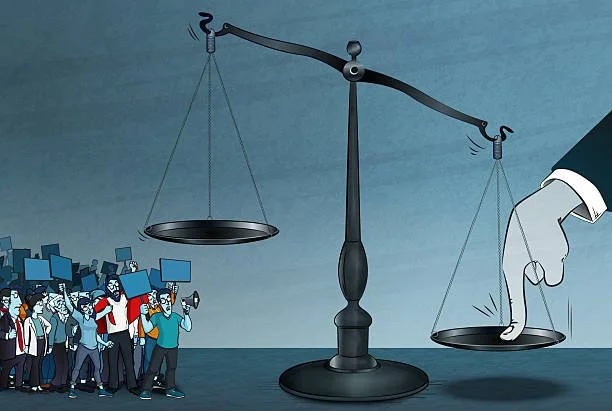
The scales of justice are not always in balance. Rather, they are a symbolic representation of the process of weighing evidence, not a guarantee of perfect equilibrium. In legal and mythological contexts, the scales may tip to reflect the greater weight of truth, evidence, or merit on one side over the other.
Justitia recognised that the law is not necessarily there to be equal; rather, laws exist to be fair. The pressure applied to the scales is not always determined solely by the evidence, but also by those presenting it. In the courtroom, it might therefore be reasonable to describe the Prosecutor as an Antagonist, the Defence as an Agonist, and the Judge as a Synergist. The Prosecutor takes action; the Defence resists or moderates that action; and evenhandedness is guided by the Judge.
This relationship does not always operate perfectly. Occasionally, over-enthusiasm by either the Agonist or Antagonist can result in erratic movement. However well-meaning the respective actions may be, tensions can arise and control may be intermittently impeded. It is the Synergist who restores order. In the courtroom, the learned Judge brings proceedings back on track — a role that aligns, in principle, with what physiotherapists seek to achieve when movement becomes erratic or poorly controlled.
Colloquial terminology does not describe the court system as equal; rather, one is entitled to a fair trial. Relax, but please keep reading. This is not a philosophical discussion about what is or is not fair within the justice system. Instead, it concerns another system of considerable importance: your personal health system.
Physics and your movement
Physics occupies a primary place in our physical wellbeing, particularly in relation to movement. As judges, you know the law — but, as a gentle reminder, Newton's Third Law of Motion states: “For every action there is an equal and opposite reaction.”
What this law does not immediately convey is what occurs when that opposing reaction encounters resistance. Consider a fall. During the descent, there may be relatively little resistance, but on impact the floor exerts force back upon the body. The further and faster we fall — and the less favourable the angle of impact — the greater the forces involved and, consequently, the greater the physical effect upon the body.
Does this sound familiar to your courtroom?
As a form of protection, systems require controls. In your courtroom, it is you — the Judge — who keeps proceedings progressing smoothly, regardless of which party may be moving beyond the bounds of control. In anatomical terms, these controllers are known as Synergists. Synergists assist movement, provide stability, and prevent unwanted or excessive motion during the performance of a task.
The three muscle roles
Muscles can be understood as operating through three principal roles. Antagonists initiate action as Prime Movers. Agonists moderate what might otherwise become overwhelming or imbalanced movement. Synergists, meanwhile, stabilise and smooth the interaction between the two.
Consider a sudden craving for ice cream. You scoop a cone, raise it towards your mouth by bending your elbow and — instead of delicately taking a lick — drive the ice cream directly into your nose.
Without appropriate muscular control, this is precisely the sort of outcome that could occur. The Agonists enable controlled movement of the arm towards the mouth, moderating the action sufficiently to achieve the intended result. They operate in concert with the Antagonists; without this coordinated interaction, the movement would neither be safe nor smooth.
The Synergists provide the additional stability required to ensure that the competing forces produce purposeful movement rather than chaos.
Training all three
Imagine the mayhem if a court system were designed solely for the Prosecution or solely for the Defence, with no Judge appointed to adjudicate between them. While this proposition sounds absurd in a legal context, it becomes considerably less so when applied to fitness and physical health.
How many people train these muscular roles in proportion to the activities they perform every day?
Many people — including highly trained athletes — effectively attempt to defy Newton's Third Law by disproportionately training one direction or pattern of movement. Consider running. Athletes readily train forward movement — the equivalent of attack — yet many sports also require substantial periods of backward movement, often in defence. Despite this, the muscles and movement patterns associated with retreat may be comparatively undertrained.
For a Judge, prolonged sitting presents a similar problem. Sitting is a highly static and, in biomechanical terms, defensive position. When maintained for long periods without adequate compensatory movement, it can contribute to muscular imbalance — not, of course, a word one wishes to hear in a courtroom.
The impact of prolonged sitting
Prolonged sitting can contribute to reduced activation of the gluteal muscles — sometimes colloquially termed “gluteal amnesia” — together with shortened hip flexors and reduced engagement of the muscles responsible for core and pelvic stability. Over time, these changes may contribute to lower-back and hip discomfort.
For this reason, exercises performed after prolonged periods of sitting should generally encourage movement back towards an elongated, upright posture and restore activity to the muscles that have remained relatively inactive.
The same principle in medicine
The broader principle of Agonists, Antagonists, and Synergists can also be observed elsewhere in health and medicine. Treatments rarely operate in complete isolation; the desired effect of one intervention may need to be balanced, moderated, or supported by another in order to achieve the best overall outcome.
The axiom of give and take, therefore, has considerable relevance to health. The givers and takers may each exert strong forces, but moderation remains necessary to create rhythm, coordination, stability, and grace.
Training is the systematic process of developing the specific skills, knowledge, behaviours, and physical capacities required for a particular task, activity, or level of proficiency. The human body deserves the same consideration.
No body wants to be spurned — and no body should be.