
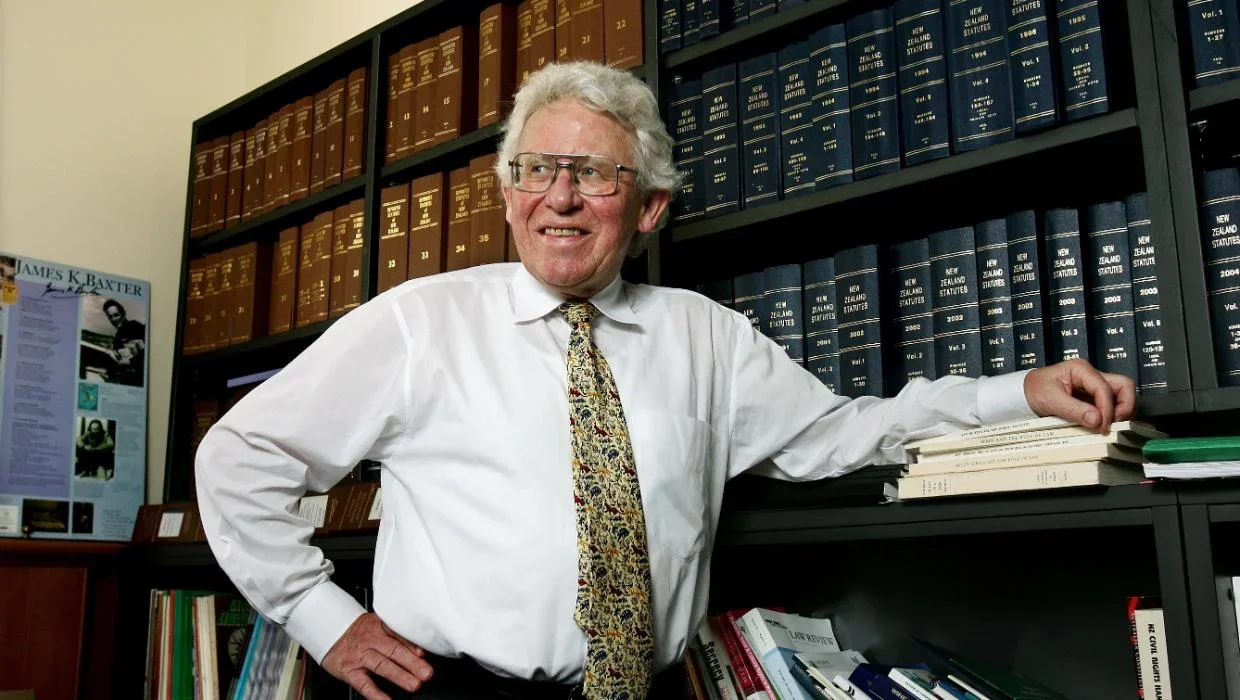
When Ken Keith passed away on 13 May 2026, the 65th anniversary of his marriage to Jocelyn, the nation lost its greatest living jurist. His achievements have been rightly celebrated, not only because they were his, but because they were ours. New Zealand is so much richer for the contributions he made to the law and to justice here and abroad. Ken indeed saw the world whole.
I do not intend to repeat what has been said about Ken by others more eloquently than I ever could. I do, however, want to acknowledge what he meant to me and my family personally.
Ken Keith brought me to this country, and for that I am forever grateful.
After I finished my articles of clerkship in Toronto, I decided I did not much like the practice of law. I decided I wanted to teach law instead. I wrote to every law school in the Commonwealth asking for a job (in the days before email and the internet, these were actual typewritten letters stuffed with a very modest CV). Ken happened to be the Dean of Law at Victoria at the time (one of several times he was Dean or Acting Dean) and for some reason hired me sight unseen to teach International Law, my dream job.
I remember my first lecture. Ken introduced me to the class. To my nervous surprise, he did not leave after the introduction. Instead, he stayed to watch the show! I can’t remember what the precise topic of my lecture was, but I must have passed muster because he did not return to monitor my performance for the rest of the trimester.
Ken used to circulate drafts of articles he was writing, seeking comment from the other international law-oriented lecturers. He did not mind that we knew a fraction of what he knew. Engaging with Ken about international law was the very model of what the academy should be – a collegial exchange of ideas that meant the world to me and lifted up his junior colleagues.
He was generous in other ways. He came into my office once and said he didn’t have time to write an article for the International and Comparative Law Quarterly, and would I mind writing one. He of course had the time, but he offered me his “slot” in this, one of the world’s most prestigious international law journals. His kindness led to the publication of my article in the ICLQ, a significant milestone in a young legal academic’s career.
Ken conscripted me onto the International Humanitarian Law Committee of the New Zealand Red Cross, a committee both he and Jocelyn held, and hold, dear. That committee reports on the domestic implementation of international humanitarian law and disseminates resources on the law of war. Ken chaired it for decades. It also runs a moot court competition each year to raise awareness of the laws of war. Needless to say, Ken enlisted me as a judge on the panel for several moot finals.
Perhaps inadvertently, Ken prepared me to become a judge (something that was definitely not in any of my plans).
He had started his career as a clerk in the Auckland Magistrates’ Court, a place full of facts. Unusually for a law teacher, he talked about the importance of facts, and of accurately finding facts, when he was a member of the International Humanitarian Fact-Finding Commission. The need to find accurate facts to which the law can be applied is fundamental to a well-functioning justice system. Everything follows from accurate fact-finding at first instance – accountability, reconciliation, and the appeal process itself. Law applied to inaccurate findings of fact weakens the whole judicial system.
There were many times when the Keiths hosted functions and dinners at their home. Jocelyn cooked and the kids served, regardless of who came to dinner. It was old Wellington hospitality at its finest. Indeed, we spent our first Christmas in this country with the Keiths. I remember a conversation I had with young Ben about comets and the solar system. Like his father, everything that went into his mind stayed there for future use. Their hospitality was endless. I remember a lovely lunch with them years later at Waikanae that re-combobulated me after I returned from being Chief Justice of Kiribati.
Ken meant a lot to me, and did a lot for me, and I don’t think I ever properly thanked him. It hurts to lose the person who started my life and career in New Zealand.
I have no doubt that my connections with Ken are not unique and have been replicated a thousandfold, and that everyone who encountered Ken will retain the benefits of those encounters. That inevitably eases the sense of loss and untetheredness I feel at losing him, and encourages in us a sense of gratitude for teaching us to see, as he did, the world whole. I think we all should be a bit more like Ken.