
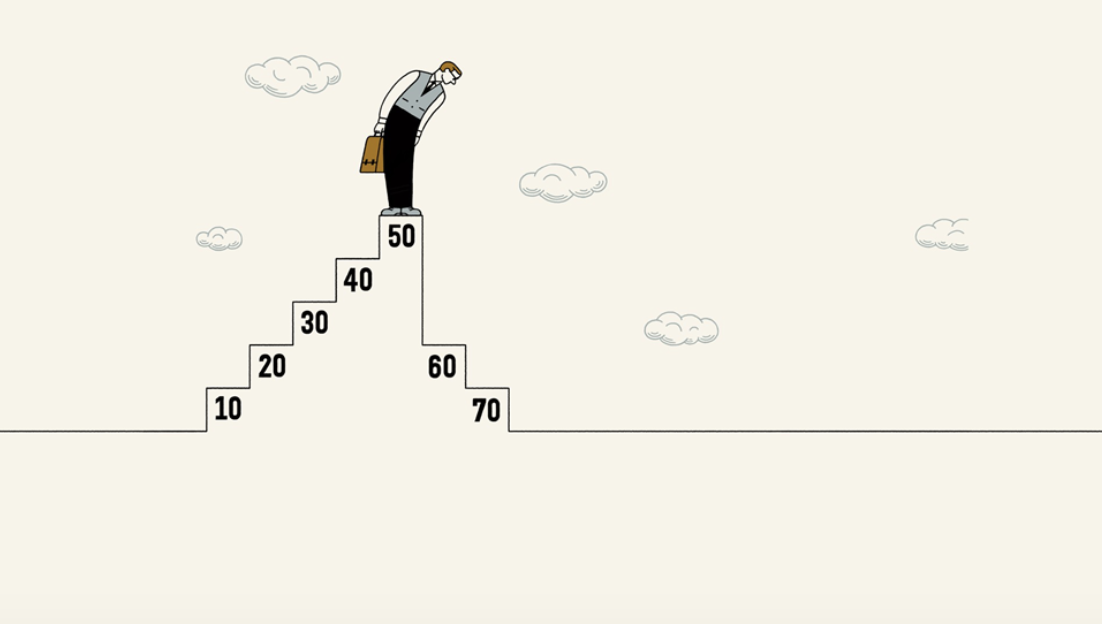
If decline is not only inevitable but also happens earlier than most of us expect, what should we do when it comes for us?
Whole sections of bookstores are dedicated to becoming successful. The shelves are packed with titles like The Science of Getting Rich and The 7 Habits of Highly Effective People. There is no section marked “Managing Your Professional Decline.”
Charles Darwin was just 22 when he set out on his five-year voyage aboard the Beagle in 1831. Returning at 27, he was celebrated throughout Europe for his discoveries in botany and zoology, and for his early theories of evolution. Over the next 30 years, Darwin took enormous pride in sitting atop the celebrity-scientist pecking order, developing his theories and publishing them as books and essays — the most famous being On the Origin of Species in 1859.
But as Darwin progressed into his 50s, he stagnated; he hit a wall in his research. At the same time, an Austrian monk by the name of Gregor Mendel discovered what Darwin needed to continue his work: the theory of genetic inheritance.
Unfortunately, Mendel’s work was published in an obscure academic journal and Darwin never saw it — and in any case, Darwin did not have the mathematical ability to understand it. From then on, he made little progress. Depressed in his later years, he wrote to a close friend, “I have not the heart or strength at my age to begin any investigation lasting years, which is the only thing which I enjoy.”
Presumably, Darwin would be pleasantly surprised to learn how his fame grew after his death in 1882. From what he could see when he was old, however, the world had passed him by and he had become irrelevant.
But some people have managed their declines well.
Consider the case of Johann Sebastian Bach. Born in 1685 into a long line of prominent musicians in central Germany, Bach quickly distinguished himself as a musical genius. In his 65 years he produced more than 1,000 compositions for all the available instrumentations of his day.
Early in his career, Bach was considered an astoundingly gifted organist and improviser. Commissions rolled in, royalty sought him out, and young composers emulated his style. He enjoyed real prestige.
But it didn’t last — in no small part because his career was overtaken by musical trends ushered in by, among others, his own son, Carl Philipp Emanuel, known as C.P.E. to the generations that followed. The fifth of Bach’s 20 children, C.P.E. exhibited the musical gifts his father had. He mastered the baroque idiom but was more fascinated with a new “classical” style of music that was taking Europe by storm. As classical music displaced baroque, C.P.E.’s prestige boomed while his father’s music became passé.
Bach could easily have become embittered, like Darwin. Instead, he chose to redesign his life, moving from innovator to instructor. He spent a good deal of his last 10 years writing The Art of Fugue — not a famous or popular work in his time, but one intended to teach the techniques of the baroque to his children and students and, as unlikely as it seemed at the time, to any future generations that might be interested. In his later years he lived a quieter life as a teacher and family man.
What’s the difference between Bach and Darwin?
Both were preternaturally gifted and widely known early in life. Both attained permanent fame posthumously. Where they differed was in their approach to life’s fade. When Darwin fell behind as an innovator, he became despondent and depressed; his life ended in sad inactivity. When Bach fell behind, he reinvented himself as a master instructor. He died beloved, fulfilled, and — though less famous than he once had been — respected.
Decline is inevitable, and it occurs earlier than almost any of us wants to believe. But misery is not inevitable. Accepting the natural cadence of our abilities sets up the possibility of transcendence, because it allows the shifting of attention to higher life priorities.
But such a shift demands more than mere platitudes. I have embarked on research with the goal of producing a tangible roadmap to guide me during the remaining years of my life. This has yielded four specific commitments.
How does one do that?
1. LEAVE — AND ENJOY RELEVANCE
The biggest mistake professionally successful people make is attempting to sustain peak accomplishment indefinitely, trying to rely on the kind of fluid intelligence that begins fading relatively early in life. This is impossible.
The key is to enjoy accomplishments for what they are in the moment, and to walk away — perhaps before I am completely ready — but on my own terms, and while still remaining relevant.
Leaving something you love can feel a bit like a part of you is dying. In Tibetan Buddhism there is a concept called bardo, which describes a state of existence between death and rebirth — “like a moment when you step toward the edge of a precipice,” as a famous Buddhist teacher put it.
Letting go of a professional life forces the question: Who am I?
I am extremely fortunate to have the means and opportunity to walk away. Many people cannot afford to do that. What’s important is striving to detach progressively from the most obvious earthly rewards — power, fame and status, money — even if you continue to work or advance a career.
The real trick is walking into the next stage of life.
2. SERVE
Time is limited, and professional ambition often crowds out things that ultimately matter more. To move from résumé virtues to eulogy virtues is to move from activities focused on the self to activities focused on others.
This is not easy for me; I am a naturally egotistical person. But I have to face the fact that the costs of catering to selfishness are ruinous — and I now work every day to fight this tendency.
Fortunately, an effort to serve others can play to our strengths as we age. Remember, people whose work focuses on teaching or mentorship, broadly defined, often peak later in life.
I am thus moving into a phase in which I can dedicate myself more fully to sharing ideas in service of others, primarily by teaching in the Pacific. My hope is that my most fruitful years lie ahead.
3. WORSHIP
“The aim and final end of all music,” Bach once said, “should be none other than the glory of God and the refreshment of the soul.”
Whatever your metaphysical convictions, refreshment of the soul can be the aim of your work, as it was for Bach.
Bach finished each of his manuscripts with the words Soli Deo Gloria — “Glory to God alone.” He failed, however, to write these words on his last manuscript, Contrapunctus 14 from The Art of Fugue, which abruptly stops mid-measure.
His son C.P.E. added these words to the score: “Über dieser Fuge … ist der Verfasser gestorben” (“At this point in the fugue … the composer died”).
Bach’s life and work merged with his prayers as he breathed his last breath. This is my aspiration.
4. CONNECT
A wealth of research strongly suggests that happiness — not just in later years but across the lifespan — is closely tied to the health and richness of one’s relationships.
Dedicating more time to relationships is not inconsistent with continued achievement.
“He is like a tree planted by streams of water,” the Book of Psalms says of the righteous person, “yielding its fruit in season, whose leaf does not wither, and who prospers in all he does.”
Think of a tree. To live a life of extraordinary accomplishment is — like the tree — to grow alone, reach majestic heights alone, and die alone.
Right?
Wrong.
The kauri tree is an excellent metaphor for a successful person — but not for its solitary majesty. Above the ground it may appear solitary, yet each individual tree is part of an enormous root ecosystem that functions together as one plant.
In fact, the kauri is among the largest living organisms in the world. Kiwi scientists have been astonished to discover how kauri stumps can keep themselves alive by drawing water from neighbouring trees.
The secret to bearing my decline — even enjoying it — is to become more conscious of the roots linking me to others.
If I have properly developed the bonds of love among my family and friends, my own withering will be more than offset by blooming in others.
The lesson for you and me — especially after 60 — is simple:
Be Johann Sebastian Bach, not Charles Darwin.
So go. Be Bach — like a tree.